Golomt Bank has been ranked 5th among Mongolia’s “Top 100 enterprises of 2025” recognizing its significant contribution to the country’s economic and social development. The annual “Top 100 Enterprises” ceremony is jointly organized by the Government of Mongolia and the Mongolian National Chamber of Commerce and Industry (MNCCI) and is being held for the 25th consecutive year. The ranking evaluates enterprises based on key indicators such as tax contributions, sales revenue, and total asset size.
In the 2025 ranking, Golomt Bank delivered strong performance across key indicators, ranking 5th in sales revenue, 7th in tax contributions, 5th in insured workforce size, and 4th in net profit, placing 5th overall.
Golomt Bank has been consistently included in the Top 100 Enterprises list for 23 consecutive years, reflecting its stable growth and strong market position. Over the past five years (2021–2025), the bank has contributed a total of MNT 982.5 billion in taxes to both the state and local budgets. This includes MNT 257.4 billion in 2025. During the reporting period, Golomt Bank’s total assets reached MNT 19.2 trillion, accounting for 22.3% of Mongolia’s banking sector assets, further solidifying its position as the second largest bank in the country.


Under its vision, “Mongolia’s Global Benchmark Bank” Golomt Bank integrates sustainable development principles and ESG (Environmental, Social, and Governance) standards into its business strategy. In 2025, the bank invested MNT 6 billion in social responsibility projects and programs, generating meaningful and measurable impact across society.
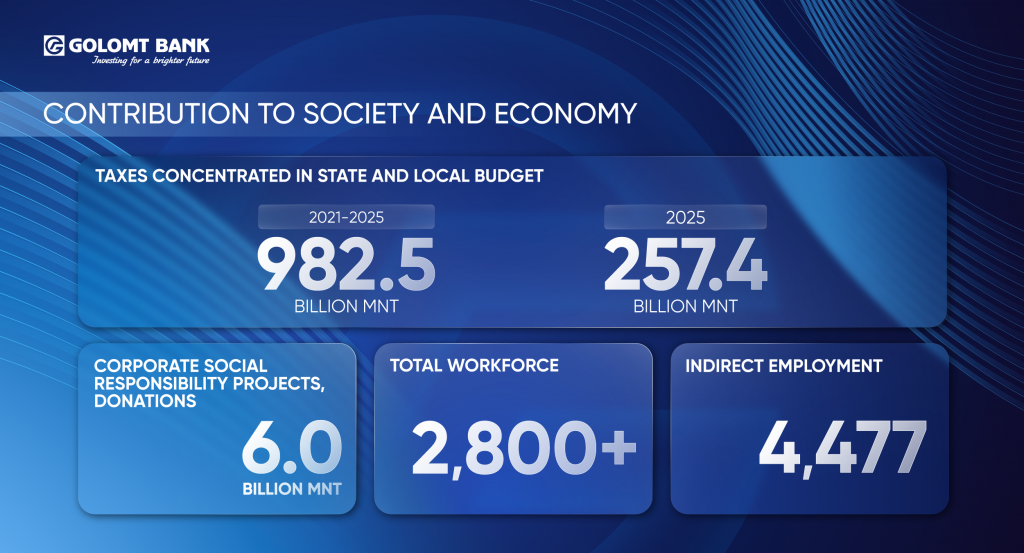

As part of its ongoing efforts to contribute meaningfully to economic growth and expand employment, Golomt Bank continues to create new jobs each year and currently operates with a core workforce of over 2,800 employees.
Furthermore, through its indirect impact, particularly via its sustainable financing initiatives and green loan portfolio, the bank has supported the creation of 4,477 jobs and generated MNT 205 billion in added economic value through savings, taxes, and salaries, while continuing to contribute to the achievement of the Sustainable Development Goals.
Investing for a brighter future